

Module 1
Module 1
1914 to 1934 - from birth to the beginning of religious life.
For your convenience, listen to the audio description of this space. You can pause or mute it at any time.

BIRTH
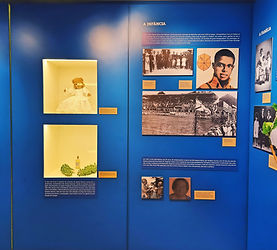
On May 26, 1914, Maria Rita de Souza Brito Lopes Pontes (Saint Dulce of the Poor) was born on São José de Baixo Street, in Barbalho neighborhood, in the parish of Saint Anthony beyond the Carmel, Salvador-BA. She was the second daughter of Dr. Augusto Lopes Pontes and Mrs. Dulce Maria de Souza Brito Lopes Pontes. She was baptized on December 13, the same year she was born. Her godparents were the siblings Joaquim and Úrsula, from the Martins Catharino family.
Saint Dulce of the Poor at two years

The family (from left to right): Maria Rita (Saint Dulce of the Poor), her father, Dr. Augusto, her siblings Aloysio and Augusto, her mother, Mrs. Dulce, with Geraldo on her lap, and her sister Dulcinha. It is noticeable that Maria Rita is the only one who smiles. At that time it was not customary to take photos this way, an attitude that represents the happy and good-natured girl she always was.
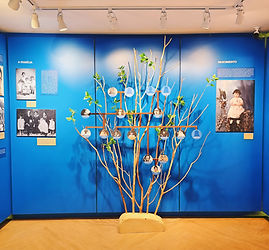
THE FAMILY
Born into a family where social action, prayer, piety and charity were part of everyday life, Maria Rita (Santa Dulce of the Poor) was influenced by the values and solidarity practices inherited from grandparents, uncles, aunts, father and mother. Her immediate family consisted of her father, Dr. Augusto Lopes Pontes, a dentist and lawyer, her mother, Mrs. Dulce Maria de Souza Brito Lopes Pontes, who was devoted to her children and home, and her siblings Augusto, Dulcinha, Aloysio, Geraldo and Regina Maria, who died as a newborn.

Dr. Augusto, at a social event with his children. Saint Dulce is the girl wearing the white hat.
CHILDHOOD
Maria Rita (Saint Dulce of the Poor), affectionately called Mariinha, had a happy childhood. She shared with her siblings the typical games of the time, such as castor bean war, kite flying, marbles and soccer. At the age of four, she received her favorite toy, the Celica doll, from her grandmother after taking castor oil, a medicine with an unpleasant taste. On Sundays, Dr. Augusto took them to Graça Field, where they would watch soccer championships. Mariinha was a fan of Ypiranga Sports Club and an admirer of the player Apolinário Santana, known as Popó.

Apolinário Santana, Popó, famous football player, from the Ypiranga Club, compared by Saint Dulce to King Pelé.

Graça Field, inaugurated on November 15th
“The biggest punishment I could receive, when I misbehaved during the week,
was not going to football matches on Sundays with my father, to watch Popó play.”
Saint Dulce of the Poor
In 1921, his mother died at the age of 26, due to complications during the birth of her daughter Regina Maria, who also died 33 days after birth. After Mrs. Dulce's death, Dr. Augusto relied on the help of his sisters Madaleninha, Georgina and Mariazinha to raise the children. The aunts, deeply religious women, provided a solid Christian education for their nephews. Despite the short time she spent with her mother, Maria Rita learned from her to love God and to follow a pious, discreet and charitable life.


The paternal aunts: 1. Georgina, 2. Mariazinha and 3. Madaleninha, the one who took SaInt Dulce of the Poor for the first time to a needy community to share donations and get to know a reality different from her own.
In 1922, Mariinha (Saint Dulce of the Poor) made her First Communion in the Church of
Saint Anthony beyond Carmel, accompanied by her siblings, Augusto and Dulcinha, her cousin Nilton and his friend Gina Magnavita, in a ceremony presided over by Monsignor Tapiranga.


Saint Dulce on the day of her First Communion.
“On difficult days, stand before the Tabernacle and speak to Jesus.”
Saint Dulce of the Poor
In 1924, his father remarried, to Mrs. Alice da Silva Carneiro. The family moved to Independência Street, in the Nazaré neighborhood. From this union, Terezinha (died at age 12) and Ana Maria were born. Life went on as normally, with Mariinha and her siblings involved in studies, games, religious commitments and social events with the family.

Dr. Augusto and Mrs. Alice, wife from his second marriage.


The sisters on their father's side, Terezinha, who died at the age of 12, and Ana Maria.
ADOLESCENCE
Aunt Madaleninha, leader of the Sacred Heart of Jesus pastoral, took Mariinha, then 13 years old, for an experience different from her reality. That day was transformative.

"From that day on, everything changed... No more soccer, no more fights, no more castor oil beans war. Then, I started thinking about how to help the poor... From this contact with poverty, with its misery, this love for the poor was born."
Saint Dulce of the Poor.
Mariinha (Saint Dulce of the Poor) as a teenager.
After this experience, Mariinha began to accompany her aunt Madaleninha on visits to needy communities and also helped the beggars who passed by her house. There was a noticeable change in her personality, becoming a more shy young woman. At the age of 13, she revealed to her father her desire to become a nun, but he suggested that she finish her education first. Obedient, Maria Rita (Saint Dulce) continued her studies at the Normal School of Bahia.

Saint Dulce of the Poor with her schoolmates. Saint Dulce is the last one sitting on the left edge.
At the age of 16, while regularly attending the Convent of Desterro, he met Friar Hildebrando Kruthaup, who became her spiritual advisor. At 17, in the same place, she met Mother Rosa Schüller, Superior of the Congregation of the Missionary Sisters of the Immaculate Conception of the Mother of God, in the Convent of Carmel, in São Cristóvão-Sergipe, during a visit she made in Salvador.

Friar Hildebrando was the one who forwarded the letter of recommendation of the young Maria Rita to the Congregation of the Missionary Sisters of the Immaculate Conception of the Mother of God.

It was through Mother Rosa Schüller that Saint Dulce of the Poor knew about the existence of the Congregation , which ignited in her heart the desire to become one of them.
BEGINNING OF ADULTHOOD
Upon completing his teaching degree in December 1932, Dr. Augusto, happy to buy her graduation ring, heard her reply: “Didn’t I say I wanted to go to the convent?” At this time, he cried, unable to argue against his daughter's dream.
Days before her trip to the Convent do Carmel, in São Cristóvão-Sergipe, she revealed to her family her desire to become a missionary in the Amazon and wrote a Letter detailing, with a brief chronology of her life, her dreams and joys.


Report letter written a few days before beginning his religious life.
On February 8, 1933, her family accompanied Maria Rita (Saint Dulce of the Poor) on a train journey to the Plataforma station, in the suburbs of Salvador, where they got off and said an emotional goodbye. She traveled alone for 323 kilometers to the city of São Cristóvão-Sergipe .At the convent, she was welcomed by Mother Johanna Bödefeld, superior of the novices.


The frontage and courtyard of the Convento do Carmo, in São Cristóvão-SE, where she began her religious life, in the Congregation of the Missionary Sisters of the Immaculate Conception of the Mother of God.

Maria Rita (Saint Dulce of the Poor) dressed in the habit of a postulant. She is the third in the back row, from right to left.
THE DREAM COMES TRUE
The days of formation led to the novitiate, which took place on August 13, 1933. The ceremony marked by the donning of the nun's habit and the joy of the religious name chosen by the congregation: Sister Dulce, a tribute to her mother.

Interior of the Carmo Church, in São Cristóvão-SE, where the ceremony of wearing the nun's habit took place.
The temporary vows ceremony took place on August 15, 1934, a year later. Her father, Dr. Augusto, attended the event and witnessed his beloved daughter's oath of poverty, chastity, and obedience. On that day, Sister Dulce (Saint Dulce of the Poor) received the ring with the Crucified Christ, made from her mother's wedding ring, and the news that she would return to her hometown for her first missions, which was not common. Divine Providence willed that Sister Dulce would become the Good Angel of Bahia.

The young nun, at her happiest moment, having fulfilled her dream of dedicating herself to religious life.
1st exposure room


Sponsors


